Visit the Ming Tombs: An Essential Great Wall Side Trip

EUGENE'S SECRET SPOT

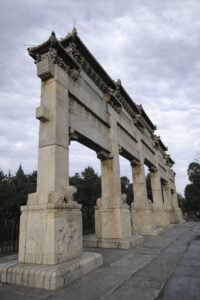
The Hidden Giant: Ming Tombs Stone Archway

When you drive with me toward the imperial tombs, don't just look for official signs. Keep your eyes on the fruit orchards along the old road. Just before the Sacred Way, a silent giant stands tall among the persimmon and apple trees.

Built in 1540, this colossal archway has stood for nearly 500 years. While most tour buses speed past on the highway, I prefer the quieter route. Seeing such imperial grandeur towering over a simple farmer's field is a surreal experience that most travelers miss.
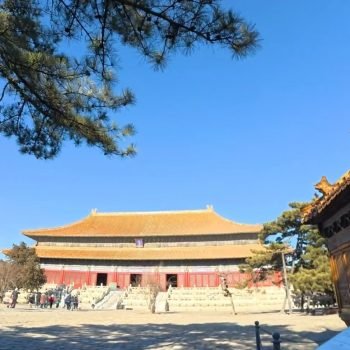
Ming Tombs Stone Archway
Incredible Scale 35 meters wide and 16 meters high. This "six-pillar, five-bay" structure is recognized as the earliest and highest-ranking stone memorial archway in China.
Masterful Craftsmanship Artisans carved solid stone to mimic royal wooden architecture, including complex "Dougong" bracket sets and "Wudian" style hip roofs.
Imperial Symbols The base stones feature intricate relief carvings of Kirin, lions, and "Cloud Dragons," demonstrating the supreme status of the Ming imperial family.
The Sacred Threshold In ancient times, this was the boundary of absolute respect. Even high-ranking officials had to follow strict rules here. For example, they had to dismount from their horses or leave their sedans.
Eugene's Photography Tip: Because this gate is far from the main crowd, it's the perfect spot for photos without tourists. It aligns perfectly with Tianshou Mountain—a masterpiece of ancient Feng Shui.

🏺 Ming Tombs Private Tour: Expert Guide to Changling, Dingling or Sacred Way

Located approximately 45km northwest of downtown Beijing, the Ming Tombs—also known as the Thirteen Tombs of the Ming Dynasty—occupy a magnificent 40-square-kilometer valley. This sacred site serves as the final resting place for 13 Ming emperors.

Every tomb was strategically situated between a hill and a stream, following the ancient principles of Feng Shui to ensure the eternal peace of the royal souls.

🏛️ Changling Tomb: Grandeur Without the Crowds

Eexpert's Insight: Most people rush through, but I recommend spending more time here to admire the Nanmu wood pillars. These 600-year-old giants are the oldest of their kind in China. As your guide, I'll help you spot the intricate details on these ancient single trunks that others often miss.

🕳️ Dingling Tomb: The Underground Fortress

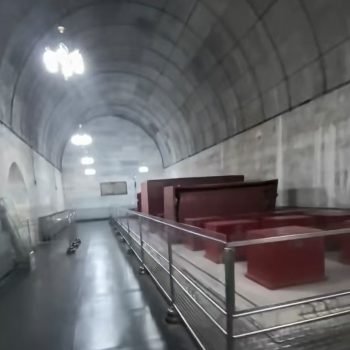
Experience tour guide's Strategy: This is the only excavated palace and is a must-see. However, the underground passages are narrow and can become congested during holidays. I’ll help you time your visit to avoid the peak domestic tour groups, ensuring a much more peaceful experience in the 27-meter deep vaulted chambers.

🏛️ The Sacred Way: The Stone Statue Gallery

Expert's Choice for Photography: If you prefer a leisurely stroll over exploring dusty chambers, the Sacred Way is a hidden gem. It is a 7km majestic approach to the tombs, lined with 36 exquisite stone statues of animals and imperial officials.

  • Expert guide's Tip: This is the most "Instagrammable" part of the valley. I recommend walking the most scenic section (about 800 meters) where the willow trees frame the ancient statues perfectly.

  • The Experience: It’s an open-air museum. Unlike the enclosed tombs, here you can truly feel the scale of the Ming Dynasty’s "Imperial Afterlife" layout while enjoying the fresh air.

📅 Plan Your Visit

  • Changling: 1 hour for grand architecture.

  • Dingling: 1 hour for the underground palace.

  • Sacred way: A comfortable walk here takes about 45 minutes.
  • Pro Tip: I specialize in combining the Ming Tombs with the Mutianyu Great Wall for a seamless, traffic-avoiding day trip in Beijing.

🚀 Mutianyu Great Wall & Ming Tombs: Choose Your Perfect Combo

Most of my clients combine the Mutianyu Great Wall with one (or more) of the Ming Tombs sites. Depending on your energy and interests, here are my top 3 recommended itineraries:

Option A: The Scenic & Easy Route (Wall + Sacred Way)

  • Best for: Families with seniors/kids or photography enthusiasts.

  • Expert guide's Insight: After hiking the Wall, the Sacred Way offers a flat, relaxing 45-minute stroll among majestic stone statues. No stairs, just beautiful willow trees and ancient art.

Option B: The Architectural Marvel (Wall + Changling)

  • Best for: Architecture lovers and those who appreciate "Real History."

  • Expert guide's Insight: Changling is the grandest of all 13 tombs. The 600-year-old Nanmu wood pillars are a sight you won't find anywhere else in the world. It’s majestic, quiet, and awe-inspiring.

Option C: The Underground Mystery (Wall + Dingling)

  • Best for: Adventurers and those curious about the "Imperial Underworld."

  • Expert guide's Insight: We will descend 27 meters into the Dingling Underground Palace. It’s the only tomb excavated. Note: It involves many steps and can be crowded on holidays—I'll help you time it right!

📅 Need a Personalized Itinerary?

Not sure which tomb fits your group best? Tell us your age, physical condition, and interests, and our planning team (led by Eugene) will customize the perfect day trip for you.

[👉 Customize My Beijing Trip Now]

Ming Tombs Private Tour: Expert Guide to Changling & Dingling
Ceremonial palace for Changling tomb
Where is the Ming tombs emperor's coffin?
Dingling: 27m Underground Palace
ing Tombs Sacred Way stone Official statue Beijing
Ceremonial stone carving official on the Sacred Way
Sacred Way Ming Tombs stone statue
Ceremonial stone carving animal on the Sacred Way

Ming Dynasty Tombs: The Ultimate Visitor Guide
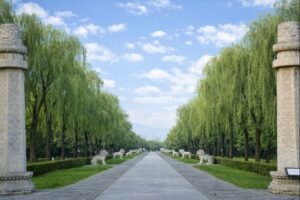
Sacred way

The Ming Dynasty Tombs, also known as the Thirteen Tombs, are located 45km northwest of Beijing. This vast imperial complex represents one of the most complete royal tomb systems in China, reflecting ancient beliefs about power, the afterlife, and the harmony between humans and nature.

Why Here? Feng Shui & Imperial Planning

The site was chosen by the Yongle Emperor based on Feng Shui principles—backed by mountains, facing open land, and nourished by water.

  • Protection: Mountains surround the site on three sides.
  • Energy: The open southern entrance allows "Qi" to flow.
  • Vitality: Ancient rivers once symbolized continuity.

This "armchair-shaped" landscape was believed to preserve imperial authority even after death.

Main Tombs Open to Visitors

Changling: The Grandest

The earliest tomb in the complex. The Hall of Eminent Favor is the largest surviving Nanmu wood structure in China, featuring massive pillars carved from single tree trunks over 600 years ago.

Visit time: ~1 hour

Dingling: The Underground Palace

The only excavated Ming tomb. You can descend 27 meters underground into the stone chambers that once housed the emperor and empresses.

Visit time: ~1 hour

Frequently Asked Questions

Q: Are all 13 tombs the same? No. Each reflects the emperor’s status, reign length, and historical circumstances.
Q: Is the visit physically demanding? The terrain is gentle, but the sites are spread out. Walking between them is not recommended—private transport is best.
Q: Is a guide necessary? Yes. Understanding the symbolism, Feng Shui, and imperial layout greatly enhances the experience.

Deep Dive into Ming History

Explore more details about the artifacts and architecture:

Granite Pillars | Animal Symbolism | Why 13 Tombs?

The Mystery of the Number 13

A common question from our guests: Why are the Ming Tombs called the "Thirteen Tombs" when there were 16 emperors in the dynasty?

The answer involves a dramatic mix of civil war, a moved capital, and a vanishing emperor.

Total Ming Emperors: 16
Buried in Nanjing (The Founder): - 1
Missing in Action (Defeated in War): - 1
Buried as a Prince (Lost Status): - 1
= 13 Imperial Tombs in Beijing

1. The Founder in Nanjing

The first Emperor, Hongwu, established his capital in Nanjing. When he died, he was buried there in the Xiaoling Tomb. He never made it to the Beijing burial grounds.

2. The Vanished Emperor

The second Emperor, Jianwen, disappeared during a palace fire after being defeated by his uncle (the future Yongle Emperor). Some say he died; others say he escaped to live as a monk. With no remains found, there is no tomb.

3. The Degraded Emperor

The 7th Emperor was temporarily replaced by his brother while held captive by Mongols. When the 7th Emperor returned and took back the throne, his brother was stripped of his imperial title and later buried as a prince in the western hills of Beijing—not in the imperial valley.

This historical "puzzle" makes the Thirteen Tombs a silent witness to the power struggles and family conflicts of imperial China.

The Mystery of Dingling Underground Palace

While there are 13 imperial mausoleums, Dingling is the only one officially excavated. This 1958 discovery wasn't easy; archaeologists spent months searching for the entrance until they found a few decayed bricks and a secret stone tablet pointing to the "Diamond Wall"—the massive stone gate 27 meters below ground.

Walking into this world of silence, you realize why the Ming emperors invested so much in their eternal homes. It is a masterpiece of underground stone architecture.
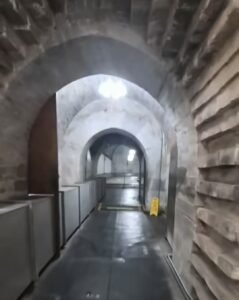
Dingling Underground Palace

Inside the Palace: 5 Silent Chambers

  • The Annexes: Secondary rooms used for grand ritual purposes in the afterlife.
  • Middle & Rear Chambers: Where the Emperor Wanli and his two empresses were laid to rest.
  • The Treasures: Archaeologists unearthed 26 chests of gold, silver, and jewelry alongside the royal coffins.
  • The Dragon Thrones: Stone thrones used by the royal couple, standing in perpetual silence in the central hall.
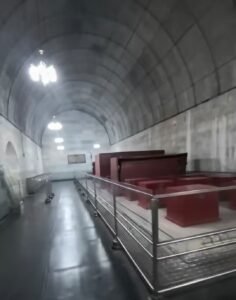
Ming Tombs Emperor's Coffins

Today, you can descend into these cool, damp chambers to see the massive white marble architecture. You'll find replicas of the imperial coffins and the "eternal lamps" that were meant to burn forever in the dark.

The contrast between the pristine ground architecture of Changling and the excavated world of Dingling is the highlight of any Ming Tombs visit.

⚠️ A Veteran Guide's Honest Advice:

I do not recommend visiting Dingling during peak holidays. The underground space is narrow and enclosed; when crowded, the somber atmosphere is lost. Depending on the season, I can help you decide whether Changling (for its grand wood architecture) or Dingling (for the underground experience) is the better choice for your trip.

The Guardians at Sacred Way: 24 Stone Animal Statues

As you stroll north from the entrance, a 30 to 40-minute walk brings you face-to-face with the "Shi Xiang Sheng"—the stone guardians of the spirit road. These 24 statues are not just art; they represent the Emperor’s imperial guard, standing as symbols of eternal power and majesty.

There are six species in total. Following the ritual requirements of the Ming Dynasty, each animal comes in a set of four: two standing to keep watch, and two sitting or kneeling to rest, symbolizing a continuous "shift" in their eternal guard.

Lion (狮子)

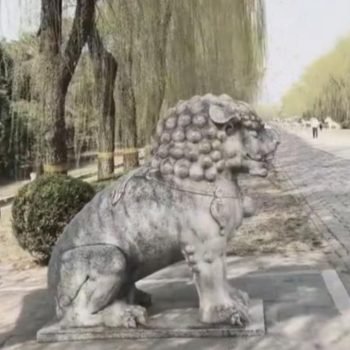
Symbols of supreme imperial authority and dignity, the lions act as the ultimate protectors to ward off evil spirits.

Standing lion statue at Ming Tombs Standing-lion
Sitting lion statue at Ming Tombs Sitting-lion

Xiezhi (獬豸)

A mythical creature known for its ability to distinguish right from wrong. It represents justice and the integrity of the court.

Standing Xiezhi statue Standing-Xiezhi
Sitting Xiezhi statue Sitting-Xiezhi

Camel (骆驼)

Representing the vastness of the Ming territory and the prosperity of international trade and communication.

Standing camel statue Standing-camel
Sitting camel statue Sitting-camel

Elephant (大象)

Symbolizing peace and stability throughout the nation. In Chinese, "elephant" sounds like "sign," representing auspicious times.

Standing elephant statue Standing-elephant
Sitting elephant statue Sitting-elephant

Qilin (麒麟)

A benevolent mythical beast. Its presence signifies good fortune and the rule of a wise and kind sovereign.

Standing Qilin statue Standing-Qilin
Sitting Qilin statue Sitting-Qilin

Horse (马)

The essential mount for military conquests. It symbolizes the military achievements and the great strength of the empire.

Standing horse statue Standing-horse
Sitting horse statue Sitting-horse

These sculptures are not only masterpieces of Ming Dynasty stone carving art but also vital components of this UNESCO World Heritage site.

The Eternal Court: 12 Human Statues

After about 20 minutes of strolling past the animals, you will reach the most solemn part of the Sacred Way. Here, 12 massive stone figures stand in two rows, forming a perpetual "Honour Guard" for the deceased emperors. These figures are categorized into three types: Military Generals, Civil Officials, and Merit Officials.

Pay close attention as you pass them—unlike the uniform look of modern statues, these Ming masterpieces possess unique personality. You'll notice a subtle "smile vs. serious" contrast in their facial expressions, as if they are still reacting to the visitors after 500 years.

Military Generals (将军)

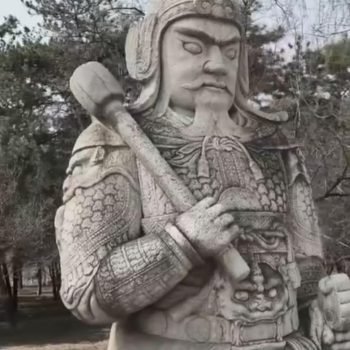
Wearing "Phoenix Wing" helmets and intricate scale armor, these generals represent the Emperor's personal bodyguard. Look closely at the "Fish Scale" or "Lock" patterns on their armor—the craftsmanship is so fine you can see every individual plate.

Ming Dynasty Military General statue holding a ceremonial hammer Military-general-holding-hammer
Standing Military General statue at Sacred Way Military-general

Civil Officials (文臣)

Dressed in traditional court robes with "Seven-beam Crowns," they hold tablets (Hu) in both hands. They represent the hundreds of civil administrators who managed the Empire's vast affairs.

Civil official statue with a subtle friendly expression Friendly-civil-official
Civil official statue with a serious, solemn expression Serious-civil-official
Expert's Note: Can you spot the difference? One official looks slightly more approachable (Friendly), while the other remains strictly formal (Serious). It’s the Ming Dynasty’s version of "Good Cop, Bad Cop."

Merit Officials (勋臣)

A unique addition in the Ming Dynasty, these figures represent counselors or military strategists. They wear a special "Diaochan Cage Hat," symbolizing high achievement in both civil service and military merit.

Merit official statue with a friendly face Friendly-Merit-official
Merit official statue with a serious face Serious-merit-official
Observation: Again, notice the facial contrast. The "Friendly" Merit official seems to welcome travelers, while his "Serious" counterpart reminds everyone of the grave dignity of this UNESCO site.

Walking between these rows of stone giants is a humbling experience, connecting you directly to the heartbeat of the Ming Dynasty’s imperial court.

Ritual Etiquette: The Alternating Poses

A unique feature of the 24 animals along the Sacred Way is their alternating poses. For every species, there are two standing and two kneeling statues. This was not a random artistic choice, but a requirement of Ming Dynasty ritual.

This design represents a symbolic change of guard. The standing statues are "on duty," while the kneeling ones are "resting," ensuring that the Emperor’s spirit path is protected 24 hours a day, through all eternity.

Mythical Guardians & Imperial Justice

Beyond real animals, the path features two sets of mythical creatures:

  • Xiezhi (獬豸): A creature known in Chinese mythology for its ability to distinguish right from wrong, symbolizing the Emperor's absolute justice.
  • Qilin (麒麟): A legendary beast representing peace and prosperity, signifying that a benevolent ruler is on the throne.

Visitor Logistics & Ticket Information

The Sacred Way is the starting point for most travelers visiting the Ming Tombs. Depending on the time of year, operating hours vary slightly:

Peak Season Apr 1 – Oct 31: 08:10 – 17:50 (Tickets: 30 RMB)

Off Season Nov 1 – Mar 31: 08:30 – 17:00 (Tickets: 20 RMB)

Note: Most travelers spend about 40–50 minutes here before proceeding to the actual burial sites.

Where to go next?

After walking the Spirit Path, you can continue to the main burial sites nearby:

  • Changling Tomb: The largest and oldest of the 13 tombs, dedicated to Emperor Yongle.
  • Dingling Tomb: The only one excavated, where you can descend into the Underground Palace.

Imperial Secrets: Why Ming Tombs located at Tianshou Mountain?

When the Yongle Emperor moved the capital to Beijing, he didn't just build the Forbidden City; he spent two years searching for a "Land of Eternal Fortune." He even invited Liao Junqing, the most famous Feng Shui master of the time, to lead the search.

The Sites That Failed the Test

Before settling on the current location, several beautiful spots were rejected for reasons that show how seriously the Ming royals took symbolism:

Tujia Camp (Rejected) The surname "Zhu" (Imperial family) sounds like "Pig." This site's name carried negative associations with the animal.
Yang Mountain (Rejected) A nearby village was named "Wolf Mouth Valley." A terrible omen for the imperial family to be "near the wolf's mouth."
Yanjia Terrace (Rejected) Its pronunciation sounded too much like a phrase meaning "The Emperor's Death" in the local dialect.
Tanzhe Temple (Rejected) Beautiful, but lacked enough space for the 13 generations the Emperor hoped would follow him.

The Winner: Tianshou (Heavenly Longevity) Mountain

In 1409, the Emperor personally stood on this ground. He saw the "Giant Armchair" layout: mountains on three sides like a protective embrace, and the Wenyu River flowing in front. He immediately declared it a “Land of Eternal Fortune.”

Eugene's Take: This selection process proves that the Ming Tombs weren't just about burial—they were about long-term vision, harmony with nature, and protecting the empire's future. When you stand here today, you can still feel that powerful "Qi" the Emperor felt 600 years ago.